Book Appointment Now

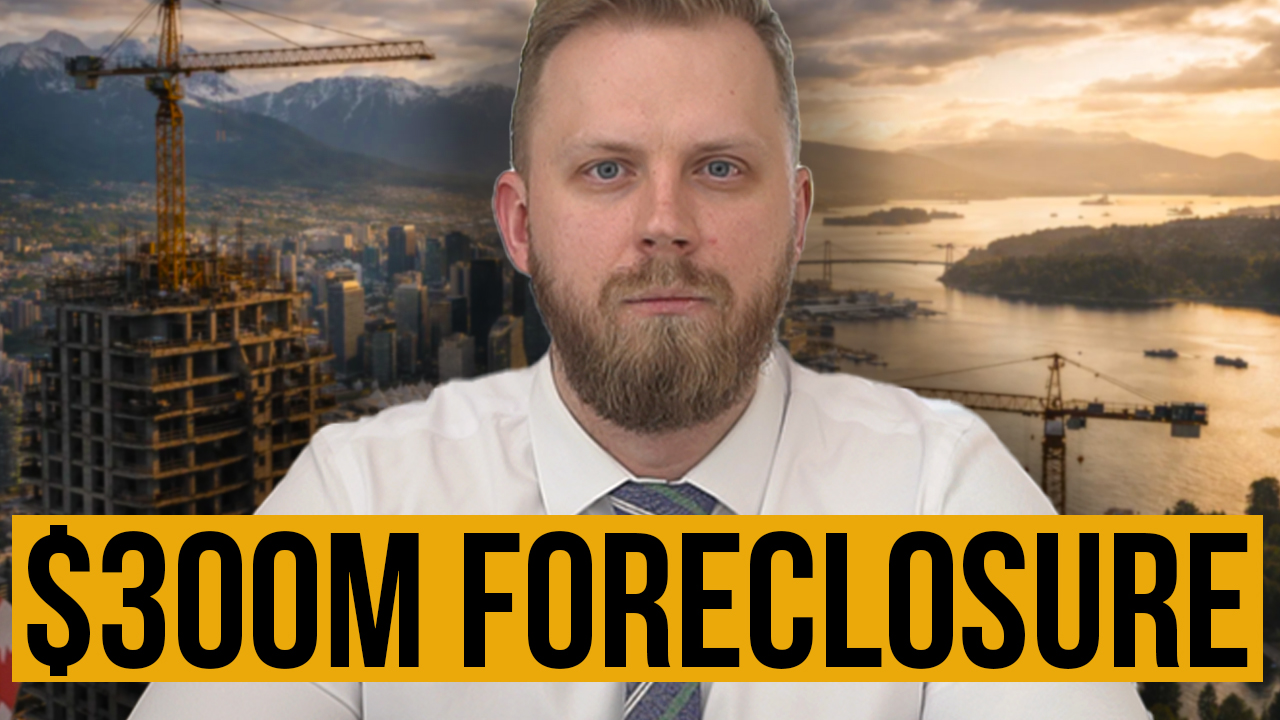
Vancouver Developer Crisis: Why $300M Projects Are Going Into Foreclosure
Something unusual — and potentially alarming — is happening in the Vancouver real estate market.
Over the past year, a growing number of large development projects have entered foreclosure or insolvency proceedings. Some developments have stalled halfway through construction, while others — including massive land assemblies worth hundreds of millions of dollars — are now in financial distress.
This trend is not limited to Vancouver alone. Across Canada, distressed real estate sales are rising rapidly, with Torontoand Vancouver leading the downturn.
In this article, we’ll break down:
- Why developer foreclosures are surging in Canada
- Two shocking examples from Vancouver and Richmond
- Why banks are now holding distressed projects instead of selling them
- Why government incentives may not be enough to rescue the pre-sale market
Distressed Real Estate Sales Are Surging Across Canada
Recent reports show a sharp increase in distressed real estate transactions nationwide.
- 2023: 119 distressed sales
- 2024: 191 distressed sales
- 2025: 252 distressed sales
That’s more than double in just two years.
And importantly, these numbers only represent properties that have actually been sold after distress or insolvency. Many other developments are currently in foreclosure proceedings but have not yet changed hands.
The real number of struggling projects may be significantly higher.
Most of these distressed developments are concentrated in Toronto and Vancouver, two markets heavily dependent on the pre-sale condo model to finance new construction.
A Half-Built Tower in Vancouver’s Broadway Corridor
One of the most striking examples of this crisis is an abandoned tower along the Broadway Corridor, an area undergoing major redevelopment.
The project was originally marketed as a 10-storey luxury building with 38 units.
Construction began in 2022.
But the project ran out of money before completion.
Work stopped around the 8th floor, leaving a partially completed structure in one of Vancouver’s most important redevelopment zones.
Key details:
- Lender: National Bank of Canada
- Debt owed: roughly $35 million
- Units pre-sold: 22 out of 38
The property is now listed in foreclosure, but selling a half-built tower is extremely difficult in today’s market.
Potential buyers must take on:
- unfinished construction
- unknown cost overruns
- regulatory hurdles
- uncertain condo demand
As a result, the bank may ultimately take a loss.
Meanwhile, buyers who pre-purchased units could face a long legal battle to recover their deposits.
The $300 Million Richmond Mega-Project in Foreclosure
If the Broadway tower is shocking, the second example is even more dramatic.
A massive 27-acre development site in Richmond is now facing foreclosure after being purchased for $300 million in 2021.
The project was intended to become a master-planned community with multiple residential towers.
But the development never moved forward.
What makes this case unusual is that the property actually generates income.
The site currently produces approximately $11 million per year in rent from 78 commercial tenants.
Despite this revenue, the developer still defaulted.
Key numbers:
- Purchase price: $300 million
- Outstanding debt: $188 million
- Current assessed value: about $244 million
At first glance, it may seem logical to simply sell the property and repay the debt.
But the problem is there are very few buyers willing to take on projects of this size in today’s market.
Many developers are trying to sell assets, not acquire new ones.
Why Banks Are Holding Foreclosed Projects Instead of Selling
Another surprising development is how lenders are handling these distressed projects.
Traditionally, banks foreclose and quickly sell the asset to recover their money.
But today, that strategy could lead to massive losses.
Industry experts say some development sites with $50–$60 million in debt may only be worth $10–$15 million in the current market.
Selling immediately could mean losses of 50% or more.
Because of this, banks are increasingly choosing to:
- take control of projects
- hold them on their books
- wait for better market conditions
In other words, lenders are delaying the realization of losses and hoping the market eventually recovers.
Why Vancouver’s Pre-Sale Market Is Breaking Down
The current development crisis is largely tied to problems in the pre-sale condo market.
Several major factors are driving the downturn.
1. High Interest Rates
Rapid interest rate increases have dramatically increased borrowing costs for developers and buyers.
Financing large projects has become significantly more expensive.
2. Construction Costs Have Exploded
Inflation, supply chain issues, and tariffs have pushed construction costs far higher than developers originally projected when many projects were planned.
3. Investor Demand Has Collapsed
Historically, investors made up the majority of buyers in pre-sale developments.
Industry data suggests:
- 70% of pre-sale units were bought by investors
- Only about 5% were purchased by first-time homebuyers
As investors exit the market, developers suddenly face a huge demand vacuum.
4. Buyers Prefer Resale Condos
Even with incentives, many buyers prefer resale properties over new construction.
Reasons include:
- lower prices
- larger floor plans
- immediate occupancy
- less risk compared to pre-construction
Will the New GST Rebate Help Developers?
The federal government recently introduced a GST rebate for first-time homebuyers purchasing new homes.
Key details:
- Full rebate for homes under $1 million
- Partial rebate up to $1.5 million
- Potential savings of about $50,000 on a $1M property
While helpful for buyers, many developers believe the policy won’t significantly boost pre-sale demand.
Why?
Because first-time buyers represent a very small share of the pre-sale market.
Most units historically depended on investors — and that investor demand has largely disappeared.
The Bigger Risk: A Development Pipeline Freeze
If developers cannot sell enough units to finance projects, many new developments may never start.
This creates a paradox:
- Today’s market has too much unsold inventory
- But tomorrow’s market could face a severe housing shortage
This boom-and-bust cycle is common in real estate development.
But the scale of distress we’re seeing in Vancouver today suggests the industry may be entering a major reset period.
What This Means for Vancouver’s Housing Market
For buyers, developers, and lenders, the current environment carries significant risks.
We may see:
- more stalled construction projects
- additional developer bankruptcies
- banks holding distressed assets
- continued weakness in the pre-sale condo market
Until construction costs stabilize, interest rates ease, and investor demand returns, many new developments may remain financially unviable.
And that means the story of developer foreclosures in Vancouver may only be just beginning.
Comments